

Wild Life
On coaching, creation, and that one question that won’t go away: What else should I have done?

Last month, I began an intensive 10-month real-life/in-person course to become a professional coach. I’m with a cohort of 30 other students from around Montréal and throughout Canada who are seeking a kind of inner jujitsu — an intentional life change to help others make intentional life change.
Coaching has both a bad name and a good one. Anyone can coach. You can coach yourself. Your mom was probably coaching you when you didn’t know it.
But what I’m learning is not therapy-lite: it is actually disciplined practice of helping others find alignment and new meaning. Coaching is about helping others find a more fulsome kind of fulfilment, giving others a chance to learn to lay down and then to re-learn. For me, it’s about offering up the golden sun when it is hidden by the greyest of clouds.
I have worked with numerous coaches over the years and almost every one of them left me with meaningful, even monumental, options and direction. I have been supported by a life coach, a number of business coaches, and a career coach.
Coaching is an offering. Mostly, it’s a conversation, a current that helps cut large mountains through small rivers. Being a coach, for me, is a kind of confession, as well — a projection of possibility into the arms of another.
My goal, which I’ll be talking more about, is to help designers, art directors and creative founders — and other entrepreneurs, freelancers, and oddballs — to build the next stages of their lives, wherever they are at.
—
Who made the world?
Who made the swan, and the black bear?
Who made the grasshopper?
This grasshopper, I mean—
the one who has flung herself out of the grass,
the one who is eating sugar out of my hand,
who is moving her jaws back and forth instead of up and down—
who is gazing around with her enormous and complicated eyes.
Now she lifts her pale forearms and thoroughly washes her face.
Now she snaps her wings open, and floats away.
I don’t know exactly what a prayer is.
I do know how to pay attention, how to fall down
into the grass, how to kneel down in the grass,
how to be idle and blessed, how to stroll through the fields,
which is what I have been doing all day.
Tell me, what else should I have done?
Doesn’t everything die at last, and too soon?
Tell me, what is it you plan to do
with your one wild and precious life?
Though it’s fall here, I think it is an appropriate time to recall the poem The Summer Day by the great Mary Oliver.
This poem is often quoted by people seeking some kind of personal and spiritual growth — and those last two lines are often highlighted, especially by coaches.
Tell me, what is it you plan to do with your one wild and precious life?
It’s not meant to be trite, but I know it can land that way.
I suggest reading it again. And perhaps ask yourself the actual question, without answering it:
What is it you plan to do with your one wild and precious life?
—
And yet, it’s the other line that won’t leave me:
Tell me, what else should I have done?
As a designer, it is a privilege and a problem to know that you can course correct. We choose green but realize later it must be grey. A photo wrongly cropped becomes an illustration rightly placed. We choose a pattern with meanings hidden from us in the unwise moment, meanings revealed later to be forsaken.
We make micro-choices in the typefaces we pick, the design systems we build, our choice of tools and plug-ins and frameworks and illustrations and icons and scales and suites and structures.
And our endless options can feel like they amount to nothing at all. The illusion of infinite edits belies a dread that they might not add up to much.
What else should I have done?
As I have mentioned previously, I could have and should have done so much better with my one precious life. There are so many regrets piled up about my one wild life that I sometimes stand on top of them like a precipice. I can see dusk for miles. But there is no Command-Z in how the stars move, at least as far as we know.
—
It’s a funny thing, our careers. Under the seemingly stable sign of late capitalism, we are allowed to make endless changes.
Nearly anything can be changed with great alacrity. We can change cities, change wardrobes, change avatars, and change partners. We can change homes, hours, and happenings. In the early mornings and evenings, we change our brain chemistry through additives and various addictions.
But we are not allowed to easily change careers.
Despite the fact that we can learn anywhere, alone and together, with access to nearly every thing that humanity has commonly collected, we can’t go from one occupation to another.
We can’t simply change our work and become that worker we’ve always wanted to be. Or, we can, but it takes time and courage and organization.
A few years ago, I was teaching design at a wonderful college in Winnipeg. I struck up a conversation with one of the instructors there who professed being exhausted by teaching after 25 years. They were awaiting retirement or, perhaps, retirement was awaiting them. I understood. I confessed that I, too, was exhausted by managing a studio for 20 years.
We joked that we should switch bodies. A Freaky Friday for the middle aged.
And why not? Theoretically, exchanging careers would not have been that difficult. The instructor could have done my job with about a month of training — and I, theirs.
But it doesn’t work that way. Our lives feel ground into the grooves of pirouetting platters and we are forced to replay the same tunes over and over again. We treat our lives and our livelihoods like machines instead of the wilderness in which we actually reside.
—
For designers, we can make daily changes to our work and the tools we use. We are easily absorbed by the absurd — the latest listicle and the laughable lol.
But I have also always thought that designers can do anything. A while back, I confessed to a friend of mine that, having worked with so many clients over the years, I could probably run a Fortune 500 company. This is less braggadocio than you might think. I’ll bet that you, too, could run a massive company, if that’s what you wanted. Designers are built to flex and when not following, they lead fluently.
—
Maybe what matters, dear designer, is not creating a life of design — but designing a life. It’s about finding your own calling, listening for what calls from the wild, if you will.
I’ll leave you with one more question that a coach asked me once.
What do you want, most of all?
Warmly,

Image of the week
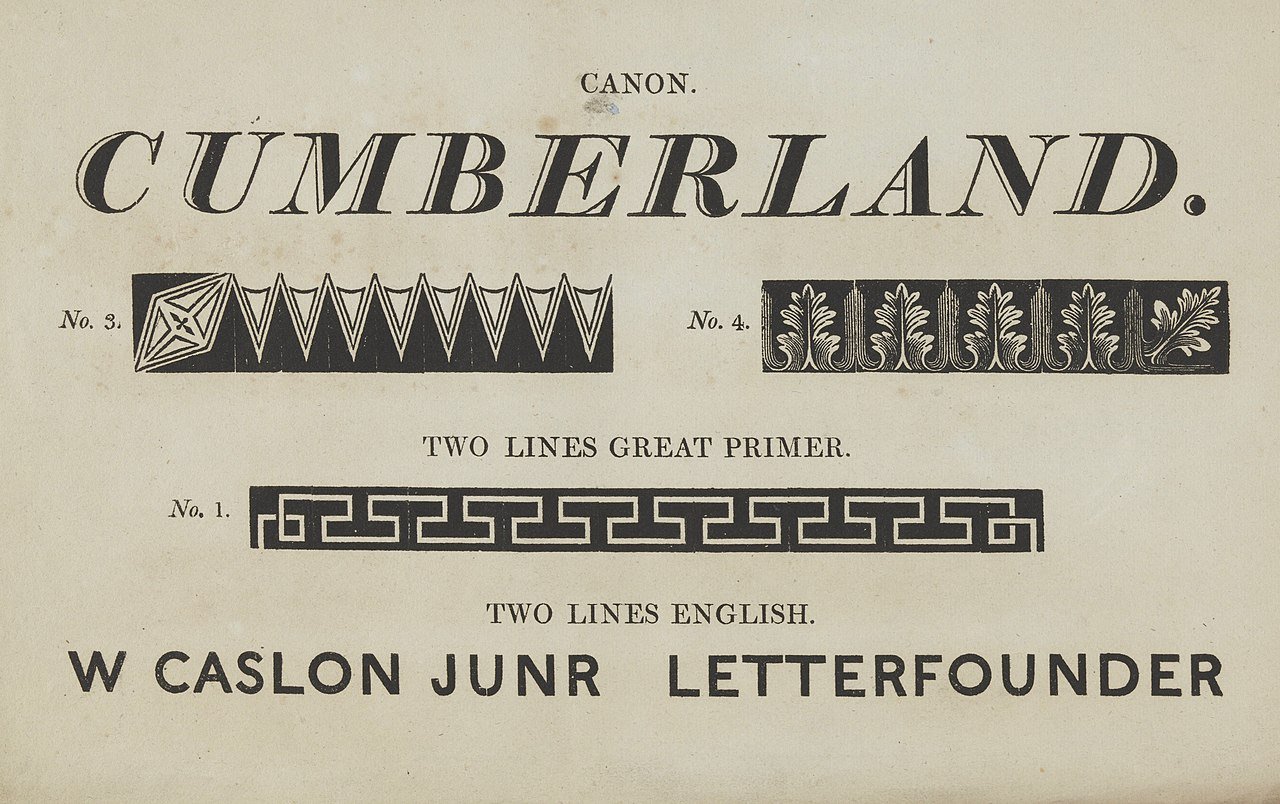

Maybe you saw this type specimen in design school? At the very bottom of this seemingly straightforward image we have “Two Lines English", the first sans-serif type for the Latin Alphabet. We tend to think of sans serifs as “modern” but this document, from 1816, indicates that we have lived with the sans for a long time. It’s not clear exactly how or why Williams Caslon IV decided to create this sans serif here, which was never put into production, but the monoline letters and circular “O” are still, to me, head-scratchingly beautiful. I particularly love that jaunty “J” and the abbreviated “JUNR”. I want to be a “letterfounder”.
Quote of the day
“Instructions for living a life.
Pay attention.
Be astonished.
Tell about it.”
— Mary Oliver (TypeQuote)
Thank you for reading. I’m honoured to be in your inbox. Wishing you a good week ahead. And Happy Thanksgiving to those in Canada who are celebrating.
If you were forwarded this email and you’d like to read more, please:
Timely article, Andrew! Thank you.
Very insightful to read this, as someone just in the beginning of the constant transformation that is the creative career. At 25, I already feel like I'm behind on things because what I want to pursue changes every week. (And now, trying to pursue what I feel called to, but feeling anxious because it's a path unique to me—therefore, I have no one to receive advice from).
Exciting to see you on the coaching track! I would imagine it to be one of the more fulfilling paths :)